
“Technique is a tool, but it’s the heart that has to talk. Don’t become a slave of choreography”.
(Charles-Guillaume Schmitt)
“Don’t give up on your dreams, find your style, listen to yourself. Listen to your heart.”
(Elena Salikhova)

An exquisite art balancing on the edge of becoming a very demanding sport, the world of Ballroom and Latin American dance is not without its pitfalls, where “life is not a walk in the park .” The French philosopher Jean Baudrillard in his work “ Simulacra and Simulation ” warns us: “ We live in a world where there is more and more information, but less and less meaning. ” In an era where almost every individual, every brand has to establish both physical and digital presence, maintaining one's artistry without delving too much into a virtual space, creating meaningful dance without completely devoting oneself to pure technicality is not an easy task. Nevertheless, in today's sometimes daunting multifaceted reality of both physical and digital dimensions, the example of Elena Salikhova and Charles-Guillaume Schmitt instills faith in the positive development of Latin American dancesport and art in general.

This couple often works in shadow but once in light mesmerises with their technical proficiency, creative power, and artistry, worth of the World Championship title and multiple Championships of France. Their shows give us the chain reaction of the chemistry that exists between two dancers on cultural and artistic levels.The choreographies are often set to the French classics, reflecting Charles-Guillaume Schmitt’s origins and Elena Salikhova’s background of living in France for many years now. Philosophical implications of their performances as if make us hear the echo of the greatest schools of thought both France and Russia have offered to this world. Their shows are more than entertainment, but an invitation to savour the dance as a poem where every step is a line that has its metaphorical philosophical meaning. And maybe even making us doubt Jean Baudrillard’s statement to some extent: existing in the world we live in, their shows, sometimes minimalistic in information on the surface, invite us to explore the depths of meaning.
In this interview we explored the artistic journey of Charles-Guillaume Schmitt and Elena Salikhova, inspiration behind, and the essence of a long-lasting partnership as a key to success in the dance world. A journey that transformed this couple of dancers into an exquisite duet representing Latin American dance sport at its finest, both in its “prêt-à-porter” collections of five dances presented at major international competitions and “haute-couture” lines of shows, where their each performance represents a work of art, unique in meaning, technique, and stage presence.

T.: Elena, Charles-Guillaume, we have just witnessed two of your shows, “Manipulation” and “Statues”, here in Paris during the recent “Paris Prestige” tournament. Both of them stand out with their extraordinary content, superb music selection, and attention to detail, like many of your other shows. How the ideas of these performances were born?
Ch-G.: The show "Manipulation" came from an idea that manipulation does not necessarily imply such a relationship between a man and a woman. We wanted to share the feeling we have about the world, that sometimes society is manipulated by other people, and sometimes we don't realise that we are being manipulated. We wanted to convey this idea in the choreography and developed it, focusing on the dynamics of relationship between a man and a woman. Although the original idea was much broader initially.
E.: In “Statues” as in many other shows we like to use French music. I think because France is actually very rich in that respect. There are many famous singers and musicians who make magnificent art, and it would be good to keep this tendency for the use of French musical heritage in our choreographies, I think it is something important.
Ch.-G.: I agree, "Statues," for example, is based on the music from the film " Amelie," which was very popular, especially in France ."Statues" came about when we were younger; we were perhaps a bit more reserved as people, and we wanted to use that aspect of ourselves in a show by depicting depicting statues that seem cold, almost lifeless, but which then come to life. We decided to show it through the music coming in crescendo.

E: The atmosphere at the beginning is a little bit more glacial, as if nothing is happening even in the eyes. Then, as soon as the music starts to play, we start to dance together, our bodies are gradually awakening.
Ch-G.: We believe that there is a soul that comes to life from within.
T.: There’s Constantin Stanislavski's quote on the interior link between spiritual life and material conditions that acquires special importance in theatre, and in life in general. Does this approach also reflect in your creative process?
Ch-G.: Yes, we also did some shows with Ton Greten, a choreographer from the Netherlands. When we went there what immediately struck me was the fact that the senses were much more heightened. There you start paying much more attention to touch, to hearing, to what you see. You don't work on technique at all when you go there. You really only work on the artistic side. I found this experience very enriching, even for our Latin American dance program afterwards. It was really something amazing.
T.: Do you think there's something that makes us say: ”Those are the dancers from France"?
Ch-G.: As being born in France, I feel that French culture is something really ingrained. I don't know if it's possible to say for sure that a distinct French dance style exists. But there’s certainly such a phenomenon as Russian dancer.
T.: What are your rituals before the shows?
E.: We try to stay in our own bubble a lot and try not to mix with the others too much. Even though we don't mind talking, we're really a bit focused. We need to warm up a little, reconnect with ourselves, and listen to music to get inspired before we start. But above all, I'd say it's important for us to be very focused.

Ch-G.: Before I step onto the stage, I like to put on my shoes, feel the contact with the ground, with my feet. And there's something else that's mandatory. It's the number on my back. Elena must put it on me. That's a must. I don't like it when someone else puts it on me.
T.: Is there a certain isolation from the audience during the performance too? What helps you convey the message to the audience in the better way artistically?
Ch-G.: Personally, during a show I can go through several phases. There are times when I really want to be in my own world, to have a precious feeling inside that I almost want to keep just for myself and not share it. And then there are other times when I really try to open up and dance more with the audience, for example. It will vary.
E.: During a performance, I'm aware of the audience, but often I only see shadows. I see people sitting around me, but when I focus, when I look, everything seems three-dimensional. On the other hand, when I'm in contact with my partner, I feel truly connected to the audience. Sometimes, more specific lighting systems are used on stage, besides spotlights, and the audience around me isn't even visible because the stage is so brightly lit. So I'm aware of people sitting around me, but I don't focus on it. I'm looking around, so to speak, but I see my partner more than I see the audience, and in the duet, I connect with the audience.
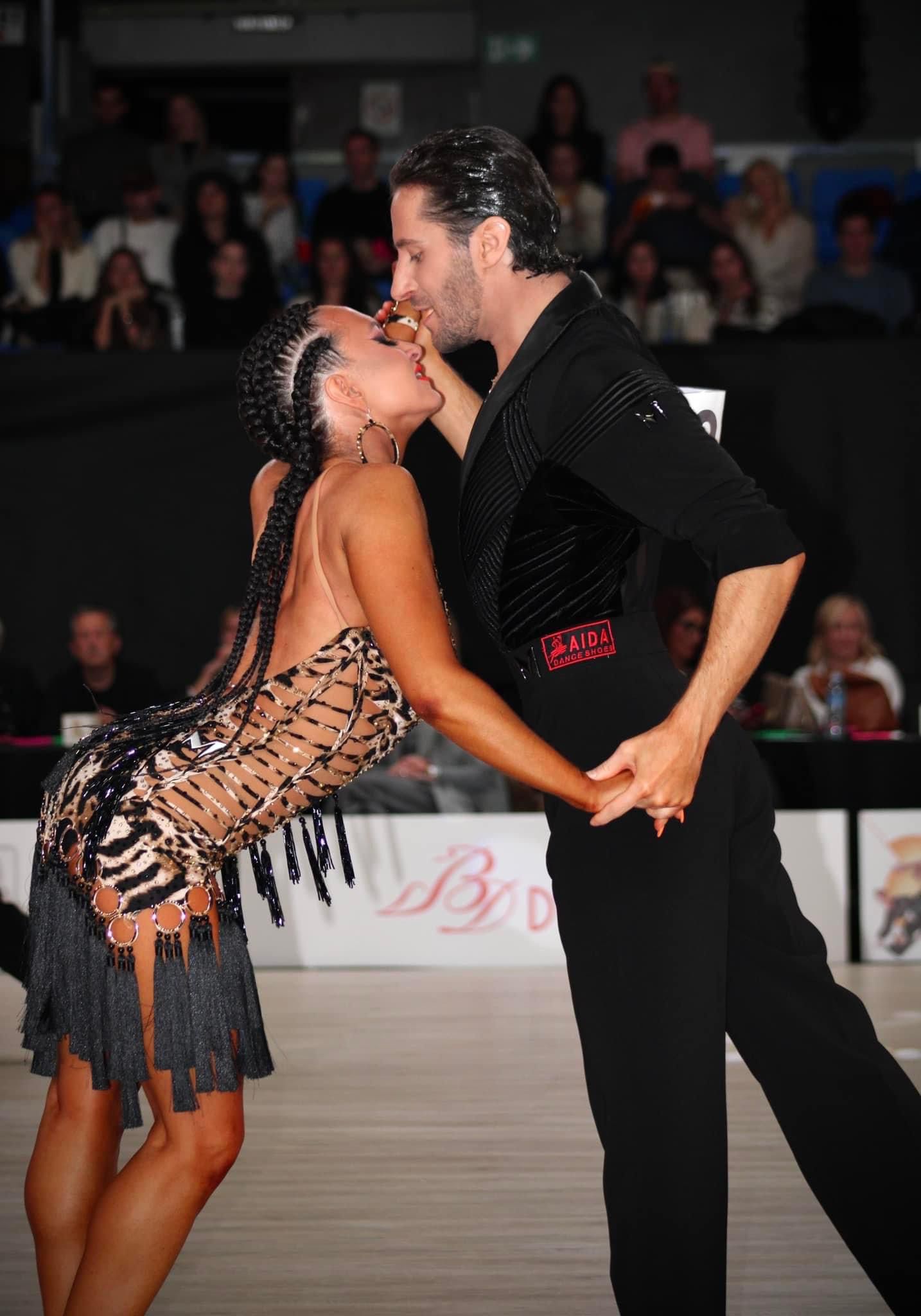
Ch-G.: It really depends on where you're dancing. Sometimes, if you're performing in a theatre, you really can barely see the audience. It's not the same as tonight on stage, where we could see the audience. Sometimes, of course, it's nice to see people around. We look at them and share our energy. They give us energy in return, and that brings us strength.

T.: In the world where the change of partners is quite normal and common, you are almost an exception: as a dance couple, you have worked and succeeded together for more than 22 years, starting in 2004. What are your views on the long-term partnership?
E.: I think it's important to create something together, and that happens step by step. There's no need to rush. Creating beautiful things takes time. So, don't give up at the first sign of difficulty. You really need to find someone you get along with, someone with whom you share the same vision of dance or something completely different, and then move in that direction.
Ch-G.: We first need to find someone who has the same goals. But after that, it takes time to really build something. And sometimes, once dancers are caught up in this adventure and encounter an obstacle, they give up instead of perhaps finding a solution to overcome the difficulty. It's crucial to find out what we can try, what solutions we can find, to truly succeed together.
E.: It's a dialogue. I think it works for married couples too. If they want their relationship to be strong, they need to communicate. And I think the same thing happens in a dance partnership. When you dance with someone, you have to communicate.
Ch.-G.: It’s like in private life. In the first few years, everything is new, everything is interesting. Then, sometimes, maybe we get bored. But we need to find what interests us in order to continue; we need to motivate and inspire ourselves, keep creating something new, and be able to move forward. The experience we have of dancing together cannot be underestimated and it played a role in making us World Champions.

T.: In your opinion, what are the pitfalls of our society and the dance world today?
E.: Personally, I think we need to be careful with the videos that are online. Being inspired is good, we all need that a little bit. We should perhaps be inspired by good videos. But we shouldn't go overboard. Perhaps also we shouldn't necessarily copy: be inspired but don’t be a carbon copy of someone else. It's true that nowadays there are so many videos, we don't even know what to watch.
Ch-G.: There is so much content out there, and we see all this information so readily available at your fingertips. The problem is that we no longer do the work of researching for ourselves. It's too easy. We watch a video and copy it. It's a shame.
E.: Back then there were the World Superstar videos coming out, whether on DVDs or cassettes. It was something we looked forward to watching: the videos with super famous dancers, the champions; we couldn't wait to see them. It was something exceptional because you couldn't see it every day. Now, with social media, YouTube, all that, as soon as you type something in, you find it. We have to be careful. We should enjoy and appreciate performances. Sometimes to appreciate the video you also need some sort of knowledge.
Ch-G: It's a bit of a shame these days. When you're competing, sometimes you see everyone in the front row with their phones, and there's always that screen between us and the audience. I find that sometimes it feels a bit strange. Sometimes we don't fully appreciate the present moment.
E.: Whether it's Donnie Burns or other famous legendary dancers, they all had their own personality, their own style. And I find that nowadays, there's a little less of that. It's hard to find your own style and follow it, whereas those legendary dancers really had distinct personalities.

Ch-G.: Sometimes these days we're a little too enslaved by technique and choreography, and we don't let our personality, our persona shine through. We really need to try to show who we are.
T.: As artists, as dancers, what is your perception of everyday life? How do you see this world? How do you see this life?
E..: In an open-minded way. You have to be open-minded, receptive, try new things, not be afraid of the unknown. I think it's also really important to stay down-to-earth, not taking yourself too seriously... Not thinking you're better than everyone else, just being genuinely down-to-earth, like this you get in touch with others easier. People can sense that.
Ch-G.: I agree. Don't be afraid to be yourself. I think that, generally, people who are truly themselves and accept themselves as they are, are the ones who have a very strong presence, a strong aura. And I agree about staying open-minded. Don’t be afraid to step outside your comfort zone. It is precisely where you grow. Don’t fear that in everyday life. If you don't feel comfortable, give yourself a kick and say: “Come on, let's go!” And go for it. Usually everything goes well!
T.: Please share some of your favourite quotes or inspiring thoughts with our future readers, professional and amateur dancers.
Ch-G.: Never give up!
E.: Try to find your own style, the one that works for you, and stick to it. Don’t give up on your dreams. Listen to your heart.

Ch-G.: As a dancer, you learn a lot, and sometimes you have to find the balance between what you learn and your feelings, your sensations. Try to blend training with letting your heart speak, Don’t becoming a slave to a choreography or technique. Always let your heart speak. Maintain a balance. Stay grounded and work on technique, but at the same time, have your head in the clouds a bit, always dream and feel that it's good to have and achieve dreams.
E.: I also have advice for those who are unsure whether to start dancing: don't hesitate, there are no age limits. I think it's never too late to start, even if it's not the easiest discipline, because there are many technical aspects that we need to adapt to and integrate into our bodies.
Ch-G.: It's really a chance not to miss when dancers can find a good team, good teachers, people with whom you feel comfortable, with whom you feel trust and kindness. That’s very important. And I think that as dancers we all belong to a truly magnificent world. It's a great opportunity to be able to perform to beautiful music, in venues that are generally so majestic. It is such an enriching experience for us as human beings. To travel, to share this joy with other dancers, this common passion, so I’d say don't hesitate, go for it!